


01 / Startups & scale-ups
Build your startup on software that can grow with it.
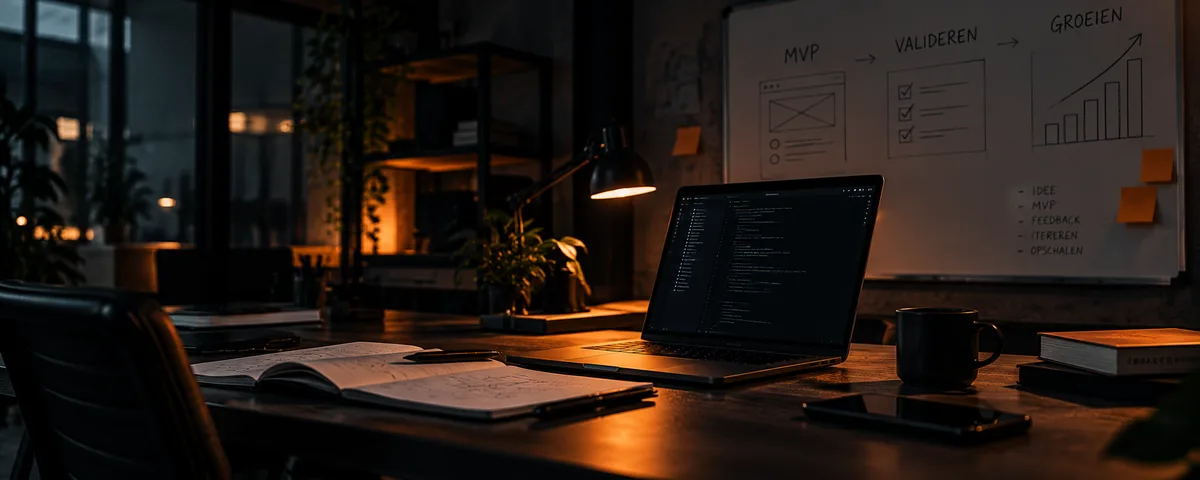
Test your idea with a first working version and scale up without having to start over later. We build alongside you as a technical partner, with direct lines to the people who write the code.
02 / Familiar challenges
Lots of plans, little time and no technical team yet.
A startup has to learn fast with little money. A scale-up has to grow without the product collapsing under its own growth. Both call for technical choices you don't make every day.
You have an idea, but no technical team.
No CTOYou know what the product should do, but not how to build it, what it costs or which choices will hurt later on.
Your first version can't keep up with growth.
Technical debtWhat was put together quickly for testing becomes slow, falls over under load or is hard to extend. And now customers are actually using it.
Investors want proof, not plans.
TractionA pitch deck is no longer enough. You need a working product and your first users to close the next round.
Your team is too small for the roadmap.
CapacityThe backlog grows faster than you can hire, and onboarding every new developer takes weeks you don't have.
03 / Where are you now?
Every stage asks for something different.
Testing an idea is different work from scaling a product. Choose the stage that fits you best. The boundaries aren't sharp, and we move along with you as you grow.
Product strategy and validation
We test your value proposition, target audience and technical feasibility, where needed with a clickable prototype you put in front of real users.
ResultKnowing whether your idea holds up before you invest in it.Discovery sprint and product roadmap
We bring the idea back to a scope you can build, with priorities, phasing and a realistic investment.
ResultA plan you can show your team and investors.SaaS platform and MVP
The smallest version real users can get to work with. Built on a foundation that can grow, so you don't have to start over later.
ResultA working product and the first data on how it is used.Development teams
Developers and product specialists who join your team, your roadmap and your codebase, and help think through what gets built.
ResultMore speed without having to hire a whole team straight away.
04 / Fast and solid
Build fast without a foundation you'll have to tear down later.
Most startups don't get stuck on too few features. They get stuck on choices made in the first few months.
Where it often goes wrong
- building everything on the list before anyone uses it;
- growing a prototype into the product until it no longer works;
- letting technical choices depend on the first freelancer who is available;
- knowledge that disappears when that one developer leaves.
How we approach it
- first choosing the assumption the first version needs to test;
- a simple architecture that can grow with you;
- proven technology instead of whatever is newest;
- code, documentation and knowledge that remain yours.
Speed and a solid foundation go together perfectly well, as long as you decide up front what doesn't need to be in yet.
05 / Why TokoWorks?
A technical partner who also thinks about the product.
As a startup, a supplier who only does what's in the quote is no use to you. You need someone who asks questions and helps think through what is and isn't needed.
We also build our own products
With MotorToko and our own platform, we know what it's like to launch a product, find users and make choices on a limited budget.
You talk to the makers
No account manager between you and the team. You discuss choices with the people who carry them out.
We think along about the business
Which feature delivers the most value for your next round or your first paying customers? We help you choose.
You stay the owner
The code, the data and the knowledge are yours. If you want to build your own team later, we help with the handover.
06 / How we start
A good conversation is the first step.
You don't need technical knowledge or a fully worked-out plan. Tell us what you want to build and for whom.
- 01 / Getting acquainted
We discuss your idea, your target audience, your timeline and where you stand with funding and team.
- 02 · Sharpen the question
Together we find the most important assumption and decide what the first version needs to be able to do.
- 03 · Proposal
You receive a proposal with scope, timeline and costs, split into phases you can decide on separately.
- 04 · Build and learn
We build in short rounds (iterations), put the first version live and adjust based on what users do.
07 / Good to know
Questions startups often ask us.
From independence and duration to what you have in hand at the end.
We already have a prototype or no-code version. Can you build on that?
That depends on how it was built. We look at it first and tell you honestly whether building on it or starting over makes more sense. Sometimes part of it is perfectly usable.
Who owns the code?
You do. We agree on intellectual property, source code and handover up front. That matters to investors too.
Can you help with technical due diligence?
Yes. For an investment round or acquisition, we can assess your codebase and architecture independently and set out the risks clearly on paper. Read more here.
Do you also work for equity or deferred payment?
Sometimes, yes. New ideas get us excited, and we like to back a strong plan. Depending on the idea, the stage and the team, we look together at what's possible, for example part in equity, a staggered payment or a smaller start. We decide that case by case, so do tell us what you want to build. Even if things are still tight financially, we're happy to think with you about a first step.
What if we want to build our own team later?
That's a good sign, and we're glad to help. We document as we go, and can onboard new developers or hand over gradually.