


01 / Professional website design and build
A website that works for your organisation.
A professional website says what you stand for, builds trust and helps visitors move forward. We combine strategy, content, design and technology in a website you manage yourself and can easily extend.
02 / Look at the problem first
Is your website still a good extension of your organisation?
A website doesn't have to be technically broken to work against your organisation. Maybe the information is still correct, but the look no longer fits. Or visitors do arrive, but find too little reason to get in touch.
Your organisation has outgrown your website
Your organisation's services, quality or size have changed, but online that is barely visible.
Visitors have to work out for themselves what you do
Services, target groups and next steps are all mixed up. As a result, it takes visitors too much effort to decide whether you fit their needs.
The website doesn't build enough trust
Case studies, results, expertise and recognisable faces get too little space, while that very proof is what helps justify a choice.
Changes take too much time
For every new page, campaign or change, you depend on a supplier or a technical colleague.
There is traffic, but few results
Visitors arrive, but clear routes, conversion points and relevant next steps are missing.
Growth makes the website hard to navigate
New services, target groups and pages have been added over time without the underlying structure being reconsidered.
03 / Direction first, then design
A new website doesn't start with colours and fonts.
Before we design, we need to understand what the website has to achieve for your organisation.
Who do you want to reach? What questions do visitors have? What should they understand within a few seconds? What proof do they need to trust you? And which next step fits their situation?
What we want to find out first.
- which target groups and customer questions are central;
- how your services or solutions are clearly positioned;
- which routes visitors can follow through the website;
- which pages are needed for that;
- where trust and proof need to be added;
- which actions you expect from visitors.
The result is not a collection of separate pages, but a website that hangs together clearly.
Target group → customer question → page → proof → next step
04 / From content to structure
Every page needs a clear job.
Not every visitor arrives with the same question. One searches directly for a service, another first wants to look at case studies, compare prices or understand how you work.
We translate those different information needs into a logical page and content structure. We look not only at the main menu, but also at internal links, follow-up pages and conversion points.
What we work out.
Main structure
Which topics deserve their own place and how do they relate?
Customer journeys
Which routes lead different target groups to relevant information?
Page structure
Which questions must each page answer before someone moves on?
Conversion points
When is it time for contact, a demo or a price comparison, and when for more in-depth content first?
Proof
Where do case studies, figures, projects, reviews or expertise genuinely add trust?
05 / Content that explains
Good design can't fix unclear content.
Good design can't fix unclear content.
A website can be visually strong and still deliver little. When the copy doesn't make clear what your organisation does, who it's relevant for and why someone should choose you, it remains mostly a nice business card.
That's why we take a critical look at:
- what can be kept from the existing website;
- which texts are too generic or duplicated;
- which important customer questions are still unanswered;
- where claims need proof;
- which new pages genuinely add value;
- which content helps visitors to a next step.

What do we expect from you?
In principle, your organisation supplies the subject knowledge, copy and images. We help with structure, topics, hierarchy and presentation.
Would you like us to write copy, completely rewrite existing content, arrange photography or migrate large amounts of content? We agree that separately.
06 / Design
Designed around your brand and content.
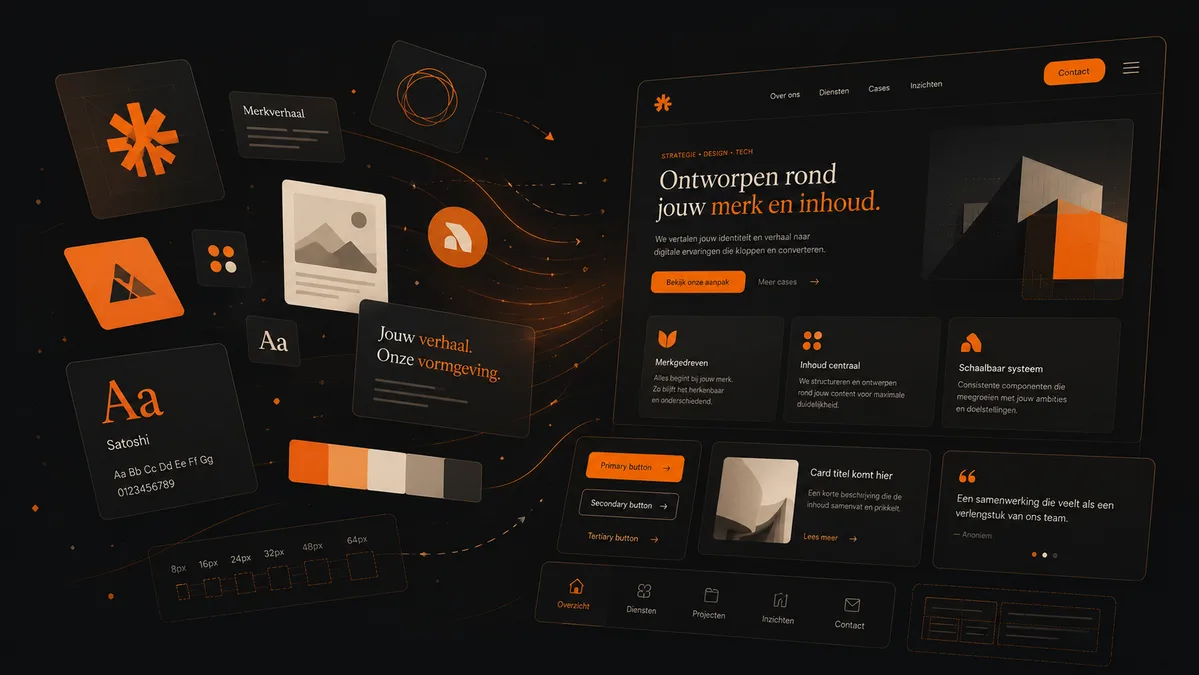
We don't start with a template into which your logo and colours are then dropped. The visual direction grows out of your brand, target group, content and the look you want.
We then translate the design into reusable components. That way pages get their own structure, while typography, colours, spacing and interactions stay consistent.
What can you expect?
- a visual style that suits your organisation;
- a recognisable structure for different page types;
- consistent components for content and conversion;
- a good display on mobile, tablet and desktop;
- enough freedom to put together new pages yourself later.
07 / Findability and results
Findability starts with the structure of the website.
SEO isn't a setting we switch on just before launch. The chosen topics, page hierarchy, URLs, internal links and content all help determine whether search engines and visitors understand what your website is about.
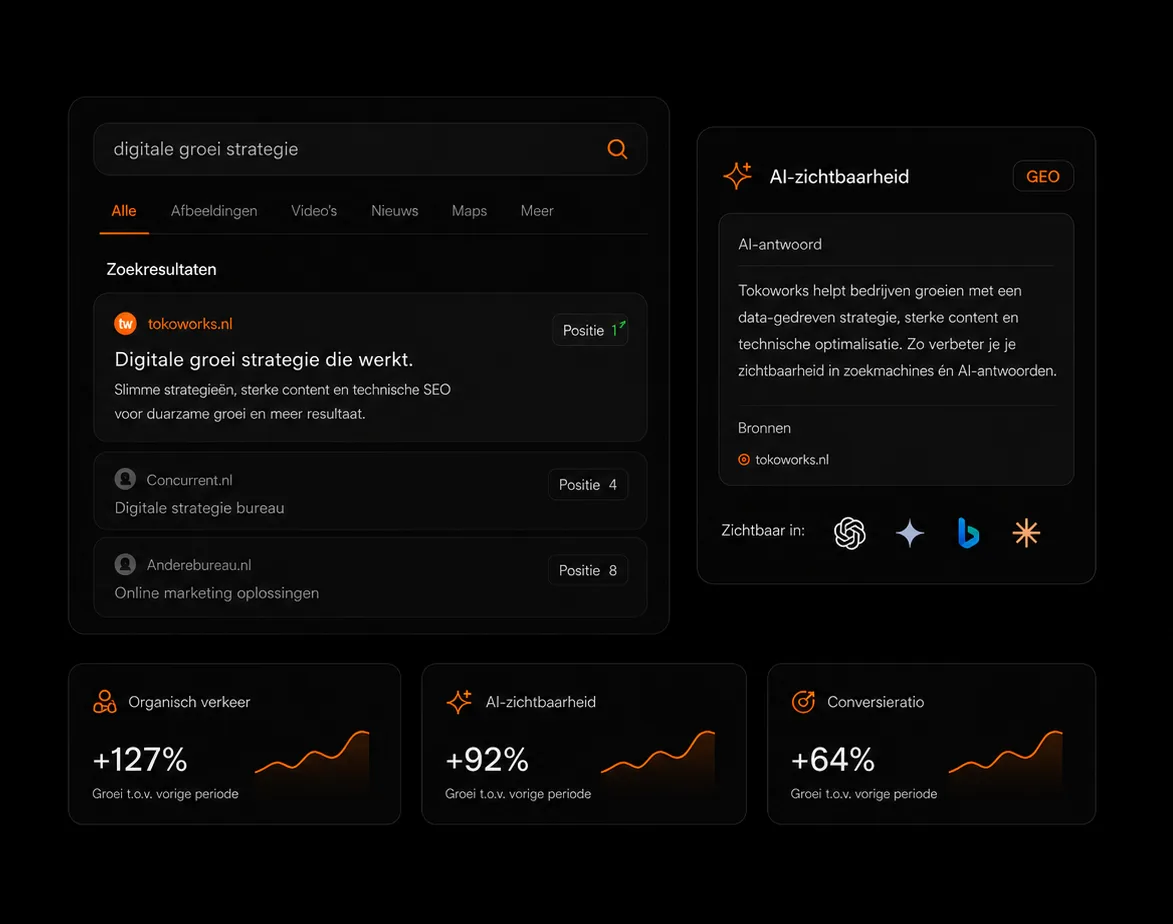
What do we do to optimise your findability?
- a logical page and URL structure;
- clear headings and content hierarchy;
- page titles and meta descriptions;
- internal links between relevant topics;
- technical indexability and sitemaps;
- redirects when existing URLs change;
- speed and mobile usability;
- measurable conversion points.
We don't promise fixed rankings or automatic growth. We do provide a strong foundation on which you can keep working purposefully on content, authority, SEO and GEO.
08 / What we deliver
From first direction to a working website.
Direction and principles
We map out goals, target groups, current bottlenecks and the most important conversions.
ResultClear principles for the website.Page and content structure
We determine the pages, hierarchy, routes and content topics that are needed.
ResultA well-founded website structure.Visual direction and design
We translate brand, content and target group into a distinctive design and component system.
ResultA design that shows how the website will work and look.Build and set-up
We build the website on the TokoWorks platform and set up the agreed pages and functionality.
ResultA working website your team can manage itself.Testing and launch
We test forms, links, mobile display, metadata, redirects and technical settings.
ResultA controlled transition to the new website.Management and further development
After launch we take care of the technology, updates, monitoring and backups. Your organisation manages the day-to-day content and can extend further later.
ResultNot a static end product, but a usable digital foundation.
09 / Who does what?
Clear agreements before we start.
TokoWorks
- Advises on structure and customer journeys
- Designs and builds the website
- Sets up the platform and the agreed pages
- Takes care of technology, hosting and maintenance
- Guides the launch
- Remains available for extensions
Your organisation
- Supplies subject knowledge and input
- Reviews choices and gives timely feedback
- Supplies copy, images and brand materials
- Appoints the decision-makers and administrators involved
- Checks content and factual accuracy
- Manages the day-to-day content after launch
Copywriting, photography, large-scale content entry, migrations, integrations and custom functionality can be provided in addition.

10 / What's included?
Design, build and technical management in one package.
Every website package includes the design, the build, use of the platform, hosting, technical maintenance, updates, monitoring and daily backups.
Migration of an existing website, custom development, integrations, content production and work outside the agreed scope are discussed and quoted separately.
11 / An honest fit
When this approach is a good fit.
There's more than one good route to a new website. Below you can see when this approach delivers the most, and when a smaller package is a better fit.
This suits your organisation when...
- the current website no longer matches your quality or ambitions;
- you want to present your propositions and target groups more clearly online;
- marketing or communications need to be able to publish independently;
- you don't want to start completely from scratch again in a few years;
- findability, campaigns and conversion matter;
- you're looking for one partner for design, technology and further development.
Business Lite is probably a better fit when...
- you mainly need a compact, professional website;
- you want to keep the content up to date largely yourself;
- little changes after launch;
- you don't need any integrations or extensions (yet).
12 / Before we start
Good to know in advance.
From brand identity and content to planning and extensions: below you can read what to expect before we start on a new website together. Is your question not listed? Get in touch using the button below.
Can you use our existing brand identity?
Yes. We can translate an existing visual identity into a suitable digital design. If the brand identity lacks sufficient guidelines for online use, we fill them in where needed.
Does all our content need to be ready before you start?
No, but early in the process we do need enough substantive input to design the structure and the most important pages properly. We agree in advance which content is needed when.
Do you also write the copy?
We always help with structure, topics and content hierarchy. Full copywriting or rewriting large amounts of text can be provided in addition.
Can we bring content over from our current website?
Yes. Together we decide which content is still usable and what would be better rewritten, merged or removed. An extensive technical or content migration is quoted separately.
How much time does the process take from our organisation?
That depends on the scope, but we will at least need input, feedback and decisions. A fixed point of contact and timely delivery prevent unnecessary delays.
How long does it take before the website is live?
That depends on the scope, content, desired functionality and how quickly decisions are made. Beforehand we draw up a realistic schedule based on the agreed website. It can be as little as a few working days.
Can we add new features later?
Yes. The platform can be extended with new components, integrations, forms, portals and other custom functionality.
Can we see the platform beforehand?
Yes. During a demonstration we show how pages, content, forms and navigation are managed.